
Collaborative Posts on LinkedIn + AI Visibility
1. Collaborative Posts on LinkedIn: The Real Benefit Isn’t Where You’d Expect
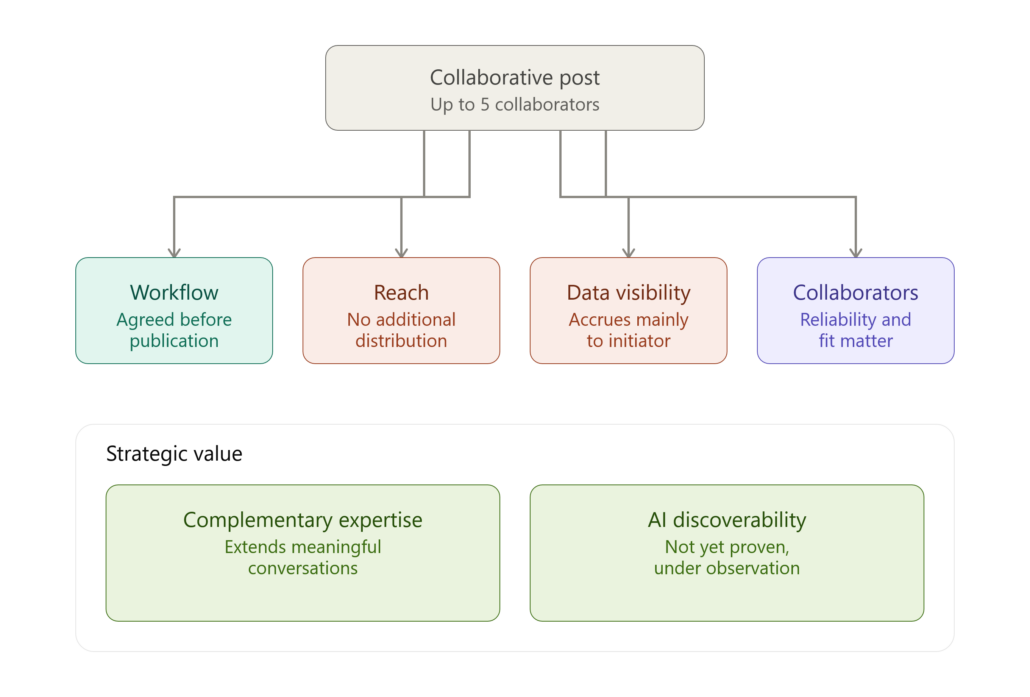
LinkedIn has introduced “Collaborative Posts”, a feature that allows a post to be published jointly with up to five other people or company pages. Rather than a simple @-mention, the post appears simultaneously on all participating profiles – with shared authorship and a shared comment section.
How it works
- Create the post The post is set up in a supported format: text, image, video, link, document, poll, event, or celebration post.
- Select contributors Up to five people or company pages can be invited to collaborate. [Screenshot: contributor selection screen]
- Send the invitation The invitation goes to the selected individuals or, in the case of a page, to its administrators.
- Wait for confirmation If accepted: the post also appears on the contributor’s profile or page, marked accordingly. If declined: the post remains visible only on the original profile.
- Publish the post Important: the post must be publicly visible – this is a prerequisite for the feature.
- Manage during the post’s lifetime Only the original creator can edit the post or manage contributors. Contributors can remove themselves from the post at any time. [Screenshot: “Remove contributors” dialog]
Responsibilities and data visibility
- Compliance with LinkedIn’s content policies is the responsibility of the person who created the post.
- For company pages, page administrators must accept the invitation on the page’s behalf.
- Page administrators can only see performance data in the page’s own analytics. Engagement metrics are not visible for pages that were merely added as contributors.
- Connections who accept an invitation as an individual can see engagement metrics such as reactions, comments, and shares.
What works well
- Contributors are displayed prominently – not just as an @-mention in the text, which often gets lost below the visible area.
- The partnership is immediately recognisable to the audience, without needing to be inferred from the post text.
- The collaboration’s performance data is shown in a combined view.
Where it still falls short
Limited breakdown of results The combined performance view currently only shows a single overall figure. A breakdown by individual contributor – for instance impressions, engagement, or audience growth per person – isn’t possible. Moreover, the analytics data is only visible to the original creator of the post.
No shared editing space LinkedIn doesn’t provide any space for joint drafting, coordination, or editing before publication. Instead, the process works like this:
- The creator writes and publishes the post.
- Only afterwards do the invited contributors receive the request.
- Contributors can neither view nor edit the post before publication.
- Once accepted, the post appears on their profile but remains unchangeable in content – control stays entirely with the creator.
Practical recommendation: wording, format, timing, and which accounts are involved should be agreed in advance, outside LinkedIn, since contributors cannot make corrections after the fact.
AI Discoverability
At present, there’s no evidence that AI systems give Collaborative Posts preferential treatment because of their multiple authorship. However, as AI systems increasingly analyse authority, expertise, and professional relationships, repeated, thematically consistent collaborations could gain relevance over time.
Strategic assessment
- The practical value lies less in increased reach than in pooling complementary expertise and continuing relevant professional conversations.
- When choosing contributors, reliability, communication style, and shared professional standards matter just as much as subject-matter fit itself.
- Posts should arise from genuinely relevant conversations (e.g. from meetings, podcasts, panels, client discussions) – not simply from a wish to use the feature.
- The post text should open with the substantive insight, not with an announcement of the collaboration itself.
Source: LinkedIn Help Center

2. What AI Actually Cites – And Why Reach No Longer Counts
Little networking. Barely any content. No references. Yet number one, when I asked an AI about providers in my field. By every conventional measure – experience, network, recommendations – this person shouldn’t have appeared there at all.
But AI doesn’t measure what we consider relevant. It reads what’s actually there – and that can have devastating consequences.
The numbers behind it
A Meltwater analysis of 9.5 million AI results confirms what I see myself:
- LinkedIn is the second most-cited source for AI systems, right behind YouTube
- 51% of cited authors had fewer than 10,000 followers (myself included, since I’ve focused on quality over quantity for years)
- 75% of results come from individuals, only 25% from company pages
So reach isn’t the lever most people assume it is.
Three things that count instead
- Recency – 48% of cited content is no more than three months old. An impressive CV attached to an inactive profile simply gives the AI no usable evidence.
- Coherence – When a profile and its posts tell different stories, the picture becomes blurry – for humans and machines alike. LinkedIn positioning is now 100% critical!
- Structure – Among the most-cited articles, 100% used lists, 92% used clear headings, 67% used concrete figures. AI picks up structure far more easily than elaborate prose.
Whoever is personally visible also shapes how their own company is perceived by AI. Where do you and your team stand?
Titles and experience remain important. But they no longer speak for themselves.
Test it yourself: ask an AI who does the work you do in your field. The result says more about your visibility than any LinkedIn analytics dashboard.