Verification under review – Search engines & LinkedIn Article/NL
🔍 Identity Verification on LinkedIn – Do You Really Know Who Receives Your Data?

I want to address an uncomfortable topic today. In every one of my training sessions, we discuss this with participants, and most of my clients who do not have access to company email verification are highly critical of it.
This week, I came across an interesting article on the topic of “Verification on LinkedIn”, which I would like to summarise briefly here (source at the end). My aim is not to spread fear, but to share facts. Ultimately, it is always you who decides whom you give which data to.
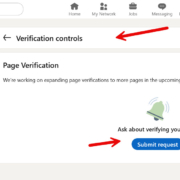
Here are the facts: When you click on “Verify” on LinkedIn, your data is not processed directly by LinkedIn. Instead, you are redirected to an external company: Persona Identities, Inc., based in San Francisco.
👉 LinkedIn is merely the customer here – your sensitive data is passed to a third-party provider.
For a verification process that takes just a few minutes, the following are collected, among other things:
- ID data including the complete document
- Selfie and biometric facial features
- NFC chip data from your passport
- Personal information (address, telephone number, etc.)
- Device and location data
🔗 In addition, Persona cross-checks your data against external sources, such as:
- Authorities and population registers
- Credit reference agencies
- Mobile network and utility providers
⚠️ The “biometric time bomb”: (You send a selfie along with it!) It is not just about photos. A mathematical facial geometry is created from your images – a unique biometric identifier. Unlike a password, your face cannot be changed.
These data can:
- Be used for AI training (“legitimate interests”)
- Be cross-checked against external data sources
- Be passed on to numerous (mostly US-based) service providers
👉 Even deletion periods are flexible: Officially, data should be deleted after a maximum of six months – unless legal requirements (e.g. US proceedings) demand longer retention.
👉 And if something goes wrong? Liability is limited to 50 US dollars. Disputes are handled through arbitration – not in court.
💡 Important: US laws such as the Cloud Act allow authorities access to your data – regardless of whether it is stored in Europe.
📌 Conclusion: For a simple verification tick, you hand over highly sensitive biometric data into a global network – with limited control and transparency.
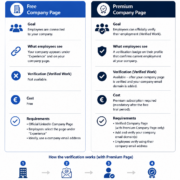
🛡️ Recommendation: check whether you can verify through your company.
A tick is merely cosmetic. Your biometric data remains.
2. AI systems are now accessing LinkedIn content on a massive scale

According to an analysis by “Profound” from March 2026, LinkedIn is the most frequently cited domain for professional queries on the major AI search platforms.
This has a clear consequence for your business: Your posts no longer appear only in the feed. They directly influence how you are found and cited in Google searches, LinkedIn searches, and especially in AI-generated answers.
In short: Today you can be discovered via Google, found on LinkedIn, and recommended as an expert by AI – or not.
The crucial question is therefore no longer: “Do you publish regularly?” But rather: “Are your posts clear enough for LinkedIn and AI to clearly associate you with the expertise you want to be known for?”
If your recent posts are too general, inconsistent or thematically too broad, it is difficult for LinkedIn to assign you clearly. And what LinkedIn does not recognise clearly, AI systems will not cite either.
That is why the simple reflection question is: If someone searched for your field of expertise today – what would LinkedIn learn about you from your last 10 posts? A clear competence profile? The specific problems you solve? Or rather a diffuse picture?
The good news: The issue is almost never the quantity of posts, but the clarity.
Three concrete action steps that show immediate effect:
- Define in one sentence the specific task or challenge for which you want to be the first choice.
- Align all future posts consistently with this positioning – with clear examples, results and your personal touch.
- Create a recognisable pattern that LinkedIn and AI clearly link to your name.
Those who implement this consistently not only increase their visibility but also build sustainable trust and authority – precisely what makes the difference in B2B sales.
3. How well are your LinkedIn articles performing?

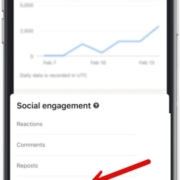
If you use the LinkedIn article/newsletter format, there is a useful new statistic. You can now see how many of your followers the article/newsletter was delivered to, how many received an email, and what the open rate of the sent emails was.
What I find interesting when looking at my own analytics is that apparently not all of my newsletter subscribers actually receive a notification email. In my view, there could be two reasons:
- The subscriber has turned off email notifications for articles/newsletters.
- LinkedIn does not deliver it to all subscribers.
I can only speculate – perhaps both?
If you use this format yourself, take a look at your post analytics. Go to your latest newsletter/article and open the analytics. There you will see (see screenshot) how your content was delivered and received.
If you are wondering why you no longer see subscribed articles/newsletters announced by email, you may have turned it off in the settings.
Here is the link for you to check: https://www.linkedin.com/mypreferences/d/notification-subcategories/newsletters
I can only hope that my assumptions are correct and the new AI is not affecting the delivery of articles/newsletters….
What are your experiences?